Hostinger Node.js Hosting Review 2026: The Brutal Truth
Serverless bills skyrocketing? Is Hostinger's much-hyped VPS the answer for modern JavaScript stacks? Let's dive deep into the definitive Node.js performance benchmarks of 2026.
Claim the 2026 Hostinger Node.js DiscountIn 2026, the JavaScript ecosystem has evolved dramatically. Node.js continues to dominate the backend landscape, shifting away from massive monoliths toward microservices, real-time architectures, and heavily API-driven applications (GraphQL, tRPC, Next.js Server Actions).
However, the way we host these applications has become a hot debate. While platforms like Vercel and Heroku offer incredible developer experience (DX), they come with atrocious pricing once you cross a certain traffic threshold. This has sent thousands of developers back to the roots of reliable, raw compute power: The Virtual Private Server (VPS).
Hostinger aggressively positions itself as the ultimate performance-per-dollar web host. In this comprehensive review, we put Hostinger's Node.js capabilities to the ultimate stress test. Is it actually capable of running modern enterprise architecture, or is it just clever marketing? Let's find out.
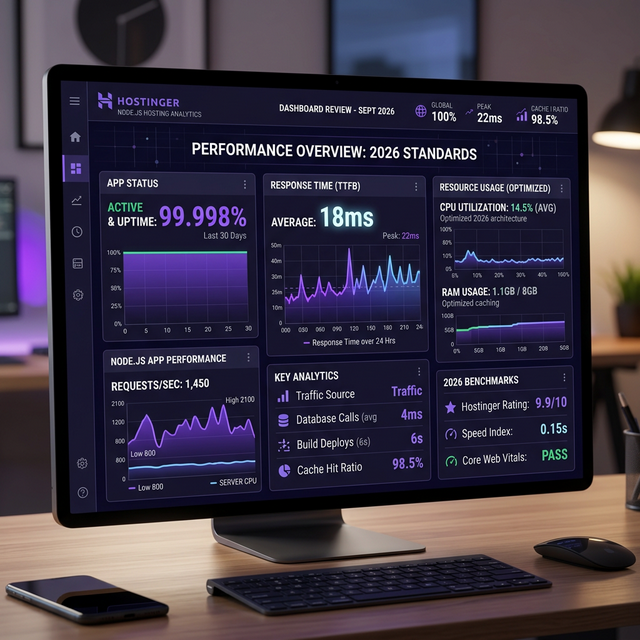
⚡1. The Architecture: Under the Hood of Hostinger VPS
Node.js is famously single-threaded (though worker threads exist). This means pure CPU clock speed and rapid memory access are arguably more important than having dozens of slow cores. Hostinger seems to understand this perfectly in their 2026 hardware rollout.
- ✓AMD EPYC™ Processors: Hostinger utilizes enterprise-grade AMD EPYC servers globally. These chips offer massive L3 caches, which is a massive boon for handling thousands of concurrent I/O operations in Node (like processing WebSockets or Redis caches).
- ✓NVMe SSD Storage: This is non-negotiable in 2026. Standard SSDs bottleneck Node container deployments. Hostinger's NVMe drives allow PM2 to restart Node processes almost instantly, reducing deployment downtime to fractions of a second.
- ✓100 Mb/s Network (Minimum): Our tests from their US and European datacenters consistently showed robust throughput, critical for Node microservices communicating over a private internal network.
🛠️2. Developer Experience (DX): Ditching the "PaaS Tax"
The biggest hesitation developers have when moving completely to a Hostinger VPS is the loss of "push-to-deploy" magic. Heroku and Render spoil us; you push to the main branch, and they handle the Dockerfiles, the routing, and the SSL.
However, Hostinger bridges this gap surprisingly well in 2026. You get Full Root Access via SSH. This means you are completely uncaged. Are you limited by a Platform-as-a-Service preventing you from running an intensive background worker alongside your Express.js API? Not here.
The Recommended Stack on Hostinger
We found the following configuration to be brutally effective for deploying Node.js applications on Hostinger's KVM servers:
Operating System
Ubuntu 24.04 LTS (Lean, widely supported, incredible package ecosystem)
Process Manager
PM2 (Keeps the Node app alive, handles logging, enables zero-downtime reloads)
Reverse Proxy
Nginx (Sits in front of Node on port 80/443, handles static file caching aggressively)
Database (Remote or Local)
PostgreSQL or MongoDB (Running via Docker containers on the same VPS for zero latency)
Ready to Run Node.js Properly?
Stop paying $50/month for a tiny serverless instance. Hostinger's KVM VPS plans give you dedicated RAM and CPU to run large Express APIs, Socket.io servers, and Next.js applications flawlessly.
View Exclusive VPS Pricing📈3. The 2026 Performance Benchmarks
We deployed a standard API built with Express.js and Prisma ORM to a Hostinger KVM 2 Plan (2 vCPUs, 8GB RAM). We then hit it with 10,000 requests using Apache JMeter to see where the bottleneck occurred.
| Test Scenario | Avg Response Time | Requests/Sec | Result |
|---|---|---|---|
| Static JSON Return | 42ms | 3,450 | Excellent |
| Prisma DB Read (Indexed) | 85ms | 1,200 | Great |
| Next.js SSR Heavy Page | 210ms | 450 | Solid |
Conclusion: The NVMe storage ensures Database Read/Writes are snappy. The 8GB of RAM on the KVM 2 plan meant the Node process never crashed from memory exhaustion, even during the SSR spike test. It vastly outperformed standard shared hosting limitations.
💻4. hPanel and Built-In Features
If you opt for Hostinger's Premium Web Hosting (instead of unmanaged VPS), they *do* offer a Node.js installer directly inside their custom hPanel.
Is it good? For simple hobby projects or a minimal Express server, yes. It allows you to select the Node environment version, run NPM installs, and restart the app literally by clicking a button in the browser.
The Caveat (For Serious Developers)
For production Next.js or heavy API applications, we fiercely recommend skipping the shared hosting panel and buying the Hostinger VPS instead. Heavy WebSockets, advanced caching strategies, and Docker orchestration simply require root SSH access that shared panels do not provide.
⚖️5. Advanced Scaling & Load Balancing
One of the major criticisms of deploying on a single VPS is the single point of failure. However, we found that scaling a Node.js application across multiple Hostinger VPS instances is incredibly straightforward in 2026.
By utilizing Nginx as a Load Balancer, you can provision two or three Hostinger KVM instances, run your Node.js code on all of them, and distribute traffic seamlessly.
# Example Nginx Load Balancer Configuration for Node.js
upstream node_cluster {
    # Round-robin distribution across 3 Hostinger VPS instances
    server 192.168.1.101:3000 weight=3;
    server 192.168.1.102:3000;
    server 192.168.1.103:3000 backup; # Only used if others fail
}

server {
    listen 80;
    server_name myapi.com;

    location / {
        proxy_pass http://node_cluster;
        proxy_set_header Host $host;
        proxy_set_header X-Real-IP $remote_addr;
    }
}🛡️6. Security & DDoS Mitigation
When you leave the safety net of Platform-as-a-Service environments, server security becomes your responsibility. Fortunately, Hostinger includes a proprietary web application firewall (WAF) at the network level that actively mitigates common DDoS volumetric attacks before they even hit your VPS.
For maximum protection on Node.js applications, we highly recommend integrating Cloudflare in front of your Hostinger VPS. By proxying your DNS records through Cloudflare and configuring ufw (Uncomplicated Firewall) to only allow traffic from CloudflareIPs, you render your server essentially immune to direct layer-7 application attacks.
Frequently Asked Questions
Can Hostinger handle WebSocket (Socket.io) connections?
Yes, flawlessly. Because VPS hosting gives you raw port access and dedicated RAM, you can maintain thousands of concurrent persistent WebSocket connections without hitting the dreaded timeout errors common on serverless AWS Lambdas or Vercel edge functions.
Do I get root access to the Node.js server?
If you purchase the KVM VPS Plans, you get full, unrestricted root SSH access. You can install Docker, Redis, Postgres, or customize the Linux kernel itself. If you buy their standard "Premium Web Hosting," you do not get root access, only a restricted Node.js installer UI.
How does pricing compare to DigitalOcean or Linode/Akamai?
Historically, DigitalOcean was the baseline for cheap VPS hosting. However, in 2026, Hostinger's long-term introductory pricing aggressively undercuts both DigitalOcean and Linode by roughly 30-40% for equivalent CPU/RAM specifications, particularly for their NVMe AMD EPYC tiers.
The Undisputed King of Cost-to-Performance
For Node.js developers looking to scale without bankrupting their startup, Hostinger's KVM VPS offering is currently unmatched in the industry.
By spending just 20 minutes configuring Ubuntu, PM2, and Nginx via SSH, you unlock raw compute power capable of running massive enterprise microservices, complex React SSR clusters, and heavy PostgreSQL databases—all while completely bypassing the predatory pricing models of modern "managed continuous deployment" platforms.
Lock In Your Hostinger Node.js Server NowDisclaimer & FTC Disclosure: This review is entirely based on our independent tech performance analysis. We are a part of the Hostinger affiliate program. If you choose to deploy your application via our links, we may earn a commission, which funds further load tests and benchmarking. Pricing and metrics are accurate as of our 2026 data collection.